If you’ve spent any real time around academy football, none of this will come as a surprise.
It’s a demanding environment. Players leave home at 16, sometimes earlier, and suddenly every training session feels like it’s being judged. One poor game can sit in your head for days.
Injuries, being left out, uncertainty around contracts, constant comparison with teammates; these things aren’t exceptions. They’re part of the weekly reality.
From the outside, especially on social media, it often looks like a dream. Inside the system, though, it can feel more like living under constant pressure.
That’s exactly why The 4Pillars Mindset Course was created. And this part matters: it wasn’t built on buzzwords or trends. The ideas behind it were independently researched, with the findings published in 2022 in the Scandinavian Journal of Sport and Exercise Psychology.
The study, “Investigating an Online Course for Player Psychosocial Development in Elite Sport (Professional Football)”, by Lee Richardson, Ricardo Lugo and Andrea Firth, examined one of the first online psychology courses designed specifically for academy footballers.

Why football needs more than “toughen up”
The research starts with a reality that people outside the game often underestimate. Professional footballers including academy players face higher risks of anxiety, depression, identity issues, gambling problems and addiction than many realise.
Those risks tend to increase during key moments: long-term injuries, dips in form, uncertainty around contracts, release from a club, or simply the growing fear that a career might not work out.
When you combine that with a culture where asking for help can still be seen as weakness, you end up with a risky situation. The mental demands are high, but the support often isn’t.
The authors argued that football can’t rely solely on reacting once players are already struggling. Instead, it needs early and structured education. Education that helps young athletes understand the pressures they’re under, recognise warning signs sooner, and develop practical tools to protect both performance and wellbeing.
In simple terms, education becomes prevention. Just like physical conditioning or technical work, psychological understanding needs to be developed early and revisited often. If you want a broader grounding in what mental performance actually is and why it matters, this complete introduction covers the full picture.
This thinking isn’t new. Back in 2014, the Professional Footballers’ Association commissioned a standardised online programme for Premier League and EFL academies. The framework behind that programme was the Four Pillars®, which now underpins the wider 4Pillars system.

Lee Richardson, Ricardo Lugo, and Andrea Firth, the researchers behind “Investigating an Online Course for Player Psychosocial Development in Elite Sport (Professional Football)”
How the researchers looked at the original course
To assess its impact, the researchers invited 219 academy players aged 16–18, along with 18 staff members from 33 Premier League and EFL clubs, to complete all eight modules of the course.
Once finished, both players and staff provided detailed written feedback. This included ratings and open responses, which were analysed using the Learning Object Review Instrument (LORI), a recognised framework for evaluating digital learning.
The assessment looked at clarity, engagement, motivation, usability and, most importantly, whether meaningful learning had actually taken place.
It provided one of the clearest early insights into how online psychology education is received inside elite football environments.
What they found: content that stayed with players
Category | Response | Frequency | Percentage (%) |
|---|---|---|---|
| Development | Helpful | 209 | 88.56 |
| Not Sure | 18 | 7.63 | |
| Not Helpful | 9 | 3.81 | |
| Access | Easy | 165 | 69.92 |
| Not Sure | 39 | 16.53 | |
| Not Easy | 32 | 13.56 | |
| Content* | Useful | 218 | 92.37 |
| Not Sure | 18 | 7.63 | |
| Not Useful | 0 | 0.00 | |
| Navigate | Easy | 167 | 70.76 |
| Not Sure | 41 | 17.37 | |
| Not Easy | 28 | 11.86 |
*No responses were recorded for “Not Useful”.
The results were strong.
Nearly 90% of players said the course supported their personal development. More than 92% found the content useful. Around 70% said it was easy to access and navigate. Feedback from staff closely matched these views.
What stood out most, though, were the open comments. Players consistently described the content as realistic and relevant to what they deal with day to day. Responses included:
It showed me how to handle different situations.
I realised things about myself I didn’t know before.
This is exactly what we go through on and off the pitch.
Players responded particularly well to real-life scenarios, stories from professionals, short videos that felt authentic, and reflective questions that encouraged self-awareness. Psychology wasn’t presented as theory. It was presented as something they recognised from their own experience.
The 2022 study gave The 4Pillars model credibility beyond that of a typical online course. It showed that players don’t just tolerate mental skills education they value it.
Enjoying this post?
If you're finding this post helpful, get more mindset insights and tools from the 4Pillars team, straight to your inbox.

How The 4Pillars system has developed since
Since that research was published, The 4Pillars framework has grown significantly in both scope and depth. What started as a course for 16–18 year old academy footballers has developed into a system used across different ages, sports and support networks.
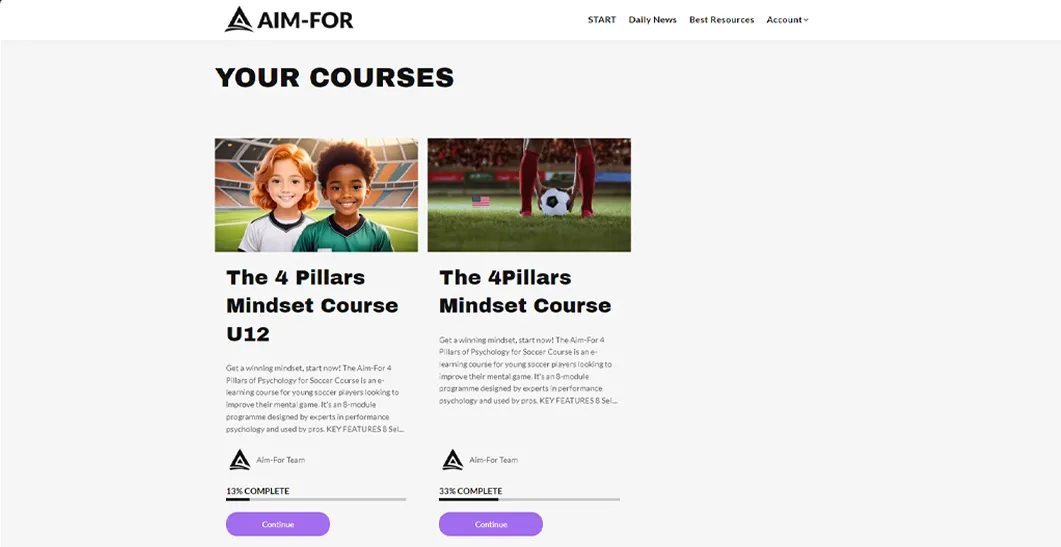
Player courses by age group
The content has been carefully adapted to reflect different stages of development.
Under 12
Focuses on simple mindset habits, confidence, emotional awareness and fun, relatable examples.
Under 16
Explores identity, motivation, handling pressure, emotional control, decision-making and performance routines.
Post-17
Aligns with professional demands, including coping with transition, managing uncertainty, building resilience and developing a mindset that can be sustained at elite level.
Together, these courses now support thousands of young athletes as they progress from early talent stages through to senior academy and professional environments.
Coach course
A full 4Pillars Coach Course now supports coaches in understanding player psychology, communicating in ways that feel safe and constructive, embedding the 4Pillars language into everyday practice, and supporting players through pressure, loss of form and key transitions. It creates a shared psychological framework between staff and players.
Parent courses
One of the most impactful additions has been the Parent Course. Parents learn how to support their child without adding pressure, regulate their own emotions, communicate effectively after performances, understand the mental demands their child faces, and avoid patterns of over- or under-involvement.
The result is a healthier overall environment around the player, not just improved individual coping.
- View The 4Pillars Mindset Course for Parents (U12) →
- View The 4Pillars Mindset Course for Parents (U16) →

Why this matters
The 2022 study didn’t just validate a single course. It validated an approach.
It showed that psychology education works best when it’s relatable, structured, age-appropriate and grounded in the realities of sport.
Because the system now spans Under 12 to senior levels, supports coaches and parents, and is expanding into sports like cricket, it offers something rare: a shared mental framework across an entire development pathway.
A child can enter the system at 10, progress through adolescence, turn professional at 18, and experience the same language, principles and mindset anchors throughout. Parents, coaches and players are aligned. There’s less confusion, fewer mixed messages, and more consistency.

Final thoughts
Football will always be demanding. That won’t change. What can change, is how young athletes understand and respond to those demands.
The 4Pillars Mindset Courses give players tools that traditional pathways often overlook. The research showed they make a difference. The system’s growth across ages, roles and sports reflects a long-term commitment, not a short-term fix.
For clubs, coaches, parents and players, The 4Pillars framework offers something genuinely useful: a practical, research-informed, sport-specific mindset system that helps young athletes perform better, feel more secure, and navigate their journey with confidence, both on and off the field.